

Hamilton Watch Co. Age determination by movement number
- Founded: 1892 in Lancaster, Pennsylvania (USA).
- Production: Pocket watches (1890–1930), wristwatches (from 1917), military watches (WW II), later (from 1969) Swiss production.
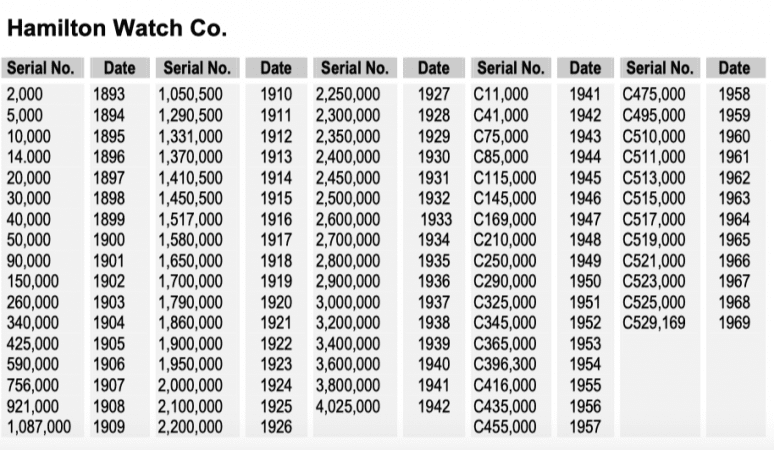
- Hamilton had its own serial number sequences for each factory series (caliber group).
-
Important: Serial number ≠ case number.
→ The age is always determined based on the serial number (on the movement plate) .
Serial numbers and years of manufacture (pocket watches & early calibers 1893–1955)
| Serial number | Year of manufacture (approx.) | Notes / Series |
|---|---|---|
| 1 – 10,000 | 1892–1895 | 936 / 940 caliber (first models) |
| 10,000 – 50,000 | 1895–1900 | 934, 936, 940, 941 |
| 50,000 – 250,000 | 1900–1907 | Railroad Gr. & 992 models |
| 250,000 – 400,000 | 1907–1914 | 992, 996, 999B (early series) |
| 400,000 – 650,000 | 1914–1924 | 992B first cycle, military watches (WW I) |
| 650,000 – 950,000 | 1924–1930 | 950, 992E series |
| 950,000 – 1,300,000 | 1930–1935 | 992E, 950E – electr. Comp. materials |
| 1,300,000 – 1,800,000 | 1935–1940 | 992B new sub-series |
| 1,800,000 – 2,300,000 | 1940–1945 | 4992B Navigation and Military Watches |
| 2,300,000 – 3,000,000 | 1945–1955 | Late 992B, 950B, Marine Chronograph etc. |
After 1955 – Swiss Hamilton (ETA-based works)
- After 1957: Hamilton took over Buren (in Switzerland).
-
From 1969: Hamilton → part of the Swatch Group (serial numbers are unsystematic / caliber number counts).
Later series (caliber 600 ff., 7750 etc.) must be dated using caliber numbers and design features , as continuous serial number lists no longer exist.
| Time period | Type of work | mark |
|---|---|---|
| 1957 – 1969 | US / Boers | Manual winding & early “Thin-o-matic” automatic |
| 1969 – 1980 | Automatic & Quartz, Switzerland | ETA-based Hamilton calibers (not consecutively numbered) |
| from 1980 | Swatch Group – modern | Serial number rarely chronological, dating via model code |
Instructions for dating by caliber number (wristwatches)
| caliber | Years (approx.) | remark |
|---|---|---|
| 987, 987A, 987S | 1926 – 1940 | Hand-wound, early wristwatches |
| 980, 982 | 1935 – 1950 | Hour hand at 6 o'clock, Art Deco case |
| 992B / 950B | 1940 – 1955 | Railroad Chronometer (pocket watch) |
| 747, 748, 752, 770 | 1948 – 1955 | Manual winding, new series after WWII |
| 665, 689 | 1957 – 1965 | Buren Micro Rotor Handmade Series (“Thin‑o‑matic”) |
| 821, 822, 826 | 1970 onwards | ETA / Buren automatic transmission, Swiss production |
Example assignment
| Engraving on work | number | caliber | Year (approx.) | Description |
|---|---|---|---|---|
| “Hamilton USA – No. 271 456” | 271456 | 936 | 1896 | early pocket watch |
| “Hamilton USA – No. 781 203” | 781203 | 992 | 1926 | Railroad Grade 21 Jewels |
| “Hamilton USA – No. 1 812 096” | 1812096 | 992B | 1941 | WWII Railroad Chronometer |
| "Hamilton - Cal. 987A" | – | wristwatch | circa 1938 | early rectangular “Brock” or “Endicott” models |
The company history of the Hamilton Watch Company
In 1928, Hamilton acquired the Illinois Watch Company . In 1931, Hamilton took over the E. Howard Watch Company and continued to produce a few smaller series under the Howard brand name. In 1941, the company developed the Model 21 marine chronometer and the Model 22 precision observation watch . With these innovations, Hamilton became one of the most important American chronometer manufacturers of the time.
From 1955 to 1960 , the Vereinigte Uhrenfabriken Ersingen (United Watch Factories Ersingen), under its new owner Helmut Epperlein, collaborated with the Hamilton Watch Company. Through this cooperation, Hamilton was able to utilize Epperlein 's developments and, in 1957, launched the first electrically powered wristwatch with a balance wheel , the " Electric ." The movement of the " Electric " featured an elongated coil on the balance wheel and a magnetic system with three magnets. This invention by Epperlein is documented as German Utility Model 1,842,778 (filed January 28, 1958 ) and was transferred to the Hamilton Watch Company, Lancaster, on September 21 , 1959 .
In 1956, Hamilton acquired the watch factory A. Huguenin & Fils in Le Locle and Biel , and the company was renamed Hamilton Watch Co. Switzerland. However, the company continued to exist as a separate brand. The development of automatic movements in Switzerland was likely a reason for this acquisition, as Hamilton did not produce its own automatic movements.
Source: Google, AI, Watchwiki
