Sammler-Uhren
Junghans Zeppelin Airship Imperial Flying Corps World War I WWI Border Watch
Junghans Zeppelin Airship Imperial Flying Corps World War I WWI Border Watch
Couldn't load pickup availability
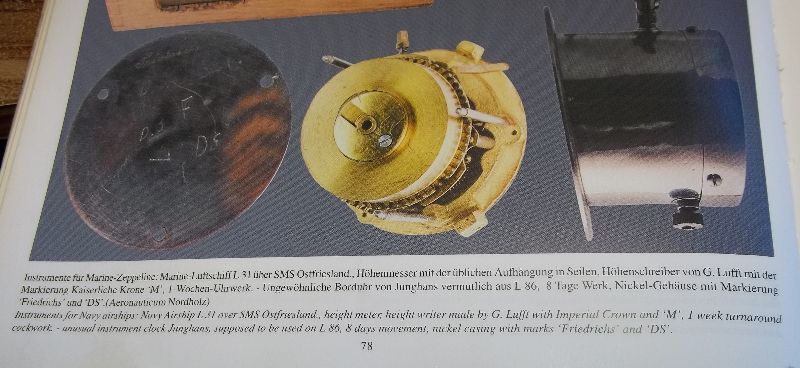
This wonderfully rare piece in this offer essentially corresponds to the one described by the "military watch pope" Konrad Knirim from LZ 86, except that the rare example in this offer must be unfolded to be wound, and the one in Knirim's had an external winding mechanism outside the case
Today we can no longer see this unique and super-rare piece of military watch history on which naval airship it served, but there is not the slightest doubt about its originality and authenticity, see Konrad Knirim page 78ff
During the entire era of airship aviation up to the Hindenburg disaster, there were exactly 130 Zeppelins in total in the Imperial German Air Service and later the Reich Air Force -
So there were exactly 130 airships in total for which this model of the original deck watch specially developed by Junghans for Zeppelins existed, and many of them burned on enemy patrols or went missing in the respective shoot-downs and crashes
An even more exclusive highlight of any military watch collection is hardly conceivable than one of definitely a maximum of 300 pieces built and deployed worldwide
Case diameter: 80mm, case height 105mm, well-preserved, unrestored porcelain dial, Junghans signed with Roman numerals, blued steel hands in Breguet style
Blued hands in Breguet style - exactly like the model shown by Konrad Knirim from LZ86, solid, concave, presumably original mineral glass, held afloat by a triple-screwed metal ring/bezel
The entire deck watch is slightly angled, which clearly identifies it as a Zeppelin instrument watch, the instrument has no metal/brass case bottom, as it was mounted on a - presumably wooden - instrument panel. The lower edge of the case has various holes for mounting
Condition: good condition for its age, the presumably original mineral glass is stable and scratch-free, bezel rings well preserved, no dents, no cracks
Can be wound softly, runs and works flawlessly (accuracy not tested - in the unfolded state, the magnificent piece of (military) watch history is wound from the back with the large, visible wheel and set with the very small one on top, good condition, dial good
Good technical and good visual condition, dial unrestored without damage, brass case well preserved, setting screws and shafts top
Good collector's condition: EZ 2 - given the age and origin, normal, visible signs of wear, runs continuously (accuracy not checked), all bezel screws present and grippy
Information on the deployment and end of military airships/Zeppelins in the Imperial German Air Service of World War I:
The first and the last of the proud giants of the sky:
Prototype LZ 1
The prototype LZ 1 (LZ for "Luftschiff Zeppelin") was 128 m long, measured 11.65 m in diameter and was powered by two Daimler engines with 10.4 kW (14.2 hp) each. To balance (trimming) the approximately 13-ton construction, a 130 kg weight that could be moved between the front and rear gondola was used. 11,300 cubic meters of hydrogen provided lift gas for lift, but the payload was only about 300 kg.
On July 2, 1900 at 20:03 o'clock, the first ascent of the airship took place in Manzeller Bay under the eyes of about 12,000 spectators on the lakeshore and on boats. The flight lasted only 18 minutes, then the winch for the counterweight broke and LZ 1 had to make an emergency landing on the water. After repairs, the technology showed some potential in the following weeks during two more ascents and outpaced especially the speed record held until then by the French airship "La France" of 6 m/s (21.6 km/h) by 3 m/s (10.8 km/h), but could not yet convince possible investors. Since the financial resources were exhausted, Count Zeppelin had to dismantle the prototype again, sell the remains and all tools, and dissolve the company.
Construction of LZ 129
On March 4, 1936, the new Zeppelin LZ 129 "Hindenburg" (named after the former Reich President Paul von Hindenburg) was finally completed and undertook its first test flight. Previously, it had been speculated that LZ 129 would receive the name "Hitler" or "Germany", but Hitler insisted that nothing bear his name, which could run the risk of being destroyed in an accident or disaster, and thus be regarded as an ill omen. In addition to the propaganda flights, the "Hindenburg" soon began to support "Count Zeppelin" on the transatlantic routes.
In the new political situation, Eckener had not succeeded in getting the helium for filling, because the USA, which still obtained it in significant quantities from natural gas as the only one, had by now imposed an embargo. Thus, after careful consideration, the "Hindenburg" was again filled with hydrogen like its predecessors, not least for economic reasons. Apart from the significantly lower procurement price of the gas, the passenger capacity increased from 50 (helium) to 72 (hydrogen) beds. The propulsion was powered by diesel engines for the first time by Zeppelin.
The end of the LZ 129
On May 6, 1937, during the landing in Lakehurst, the tail of LZ 129 caught fire, and within seconds the largest airship in the world went up in flames. The exact cause of the Hindenburg disaster remained initially unexplained. Although there was often speculation about a possible act of sabotage (by the National Socialists or also by their opponents), old and newer findings clearly support an accident scenario in which the novel paint of the Zeppelin played a fatal role. After that, the hull caught fire due to electrostatic discharge, so that finally the hydrogen also ignited.
Hugo Eckener's theory about the Hindenburg disaster assumes that a too sharp turning maneuver caused a tension wire inside the Zeppelin to snap, which damaged a hydrogen cell. The hydrogen flowing upwards at the stern of the airship ignited through static electricity, caused by a second thunderstorm front over Lakehurst, and the lowering of the ropes to the ground crew, whereby the Zeppelin was grounded.
A similar theory states that the hydrogen flowing upwards was not ignited by static electricity, but probably by sparks from a power cable of an engine.
One way or another, the disaster at Lakehurst marked the end of German airship aviation. Confidence in their safety was permanently destroyed, and further passenger transport in hydrogen-filled Zeppelins was from then on unthinkable. LZ 127 "Count Zeppelin" was decommissioned one month after the disaster and converted into a museum.
Only test flights with LZ 130
Hugo Eckener continued to try to procure helium from the USA for the sister ship of the "Hindenburg", LZ 130 "Count Zeppelin II", but to no avail. The airship intended as the new flagship of the Zeppelins was completed in 1938 and undertook, again filled with hydrogen, several workshop and test flights, but never carried passengers. Another project, which was to surpass even the "Hindenburg" and the "Count Zeppelin II" in size, LZ 131, never got beyond the production of a few ribbing frames