Sammler-Uhren
Longines Lindbergh Unisex Hour Angle Watch L 628.1 Solid Gold Bezel
Longines Lindbergh Unisex Hour Angle Watch L 628.1 Solid Gold Bezel
Couldn't load pickup availability
The aviation pioneer Charles Lindbergh, who was the first person to fly non-stop across the Atlantic in 1927, thereby already making world history, later distinguished himself as an inventor and designer of highly innovative (military) watches. Especially the "Charles Lindbergh Hour Angle Watch" developed in its original form in 1931 with a rotatable bezel and an inner dial disc with 180-degree division rotatable via the crown
The Hour Angle Watch had a rotatable inner auxiliary dial, which could be easily adjusted and aligned with the new radio signal of what was initially the US Army – an invention and patent of Charles Lindbergh. Thus, pilots were able to synchronize their navigation watches with the radio pulse, i.e., official time, in a matter of seconds without taking off their gloves or fumbling with the crown (see article from Watch Wiki below)
Description:
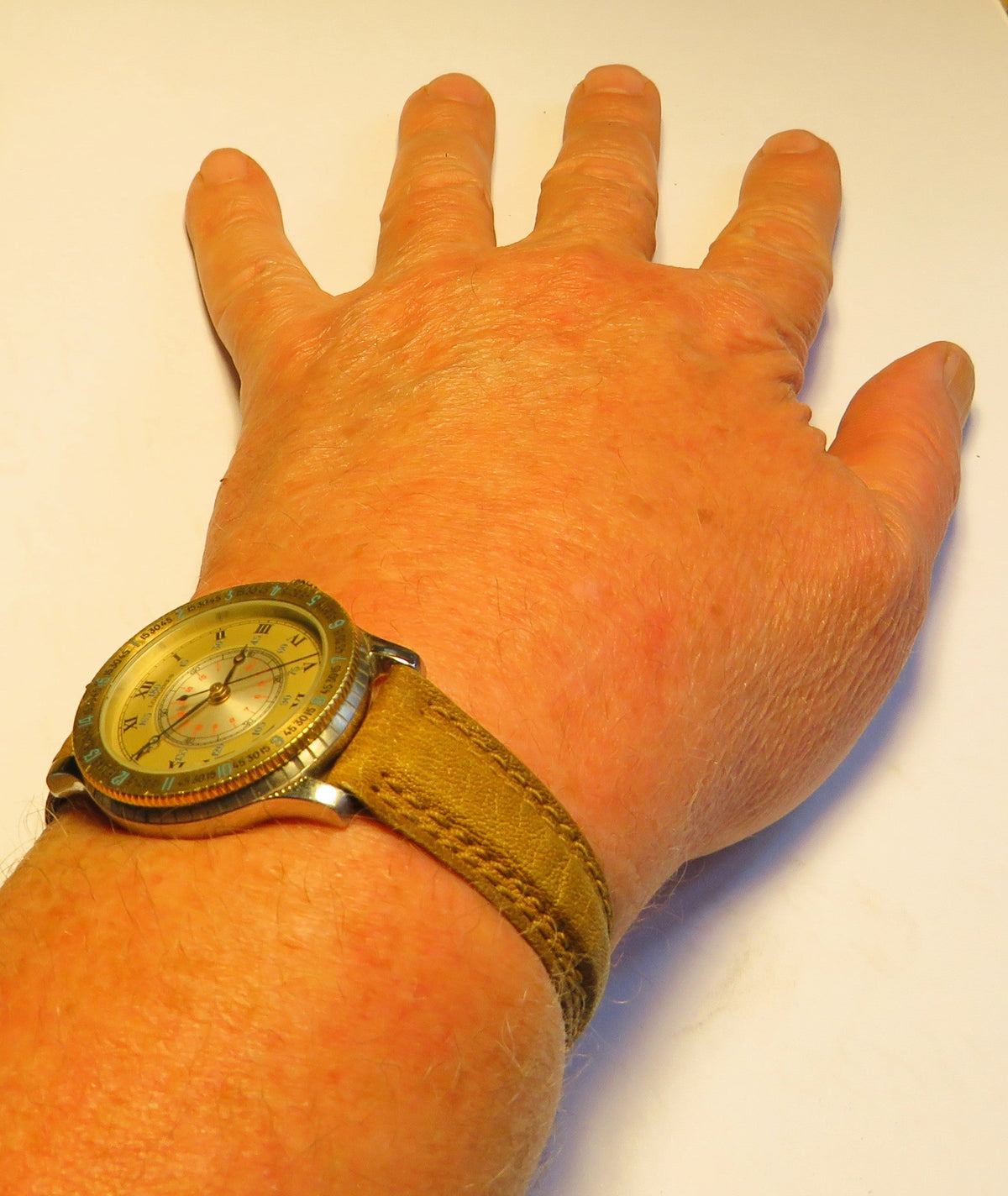
This is a unisex model wearable by both women and men, case diameter 32mm, slim original Longines genuine leather strap in light brown with gold pin buckle
Signed case back pressed, housing the legendary Longines automatic "Hour Angle Caliber" L 628.1
The modern (approx. 1990) watch in this offer has many quality features of the legendary original from 1933:
- robust mechanical Longines Cal. L 628.1 movement with fine regulation
- orig. dial with 180 degree display and rotatable inner auxiliary dial
- indicated onion crown and knurled bezel for operation and adjustment with pilot's gloves
- high-quality mineral glass
Original Longines genuine leather strap with pin buckle, solid rotatable genuine gold bezel, the gold value alone of which is likely to be almost 200 - 300 euros
The impressive piece of design, technology, and watch history starts and runs (accuracy not tested)
Condition: 1-2 good age-related condition, immaculate unrestored dial, rotatable genuine gold bezel as well as crown sharply serrated and without abrasion, starts and runs, signed case back shows scratches and opening marks
History of the legendary pilot's watch "Charles Lindbergh Hour Angle" (Source: Watch Wiki):
The American aviation pioneer Charles A. Lindbergh, who on May 20, 1927, was the first to cross the Atlantic alone in a single-engine aircraft "Spirit of St. Louis" from New York (Roosevelt Field, 07:52) to Paris (Le Bourget, May 21, 22:22), used his experience with the problem of rapid position determination to advise Longines on the development of a special wrist watch that would allow for relatively easier and faster determination of longitude using a sextant, a radio signal, and a star chart. This pilot's watch became a milestone in the watch world.
After Lindbergh had recovered from the rigors of the Atlantic crossing in his hometown of St. Louis, the trained mechanic made initial sketches of a wrist watch specifically tailored to the needs of a pilot during a long-haul flight. Around the turn of 1930/1931, Lindbergh put his sketch in an envelope and sent it to John P. V. Heinmüller, the president of the "Federation International of Aviation" (F.I.A.) in New York City.
He was, on the one hand, director of Longines Wittnauer-Watch Co. in America, and on the other hand, a passionate pilot, who immediately liked the sketches and immediately set off to Saint-Imier at the next opportunity. After just five months - March to August 1931 - the design of the first Hour Angle Watch was completed. The ingenious construction idea, according to which the watch could be quickly synchronized with the time signal on the radio by means of a central, rotating auxiliary dial, did not come from Lindbergh, but from the American commander and navigation instructor Philip van Horn Weems. Lindbergh's idea was merely an extension of Weems' construction, which was filed with the US Patent Office two years later (1929) under No. 2008734. Even before the actual Hour Angle Watch of 1931, a corresponding watch was produced by Longines in the year of the Atlantic crossing. (see: Longines Weems).
Its designation "Hour Angle Watch" came from the fact that the most important part for determining longitude, the hour angle of Greenwich, could be read directly from the watch.
In August 1931, this watch was launched simultaneously in Europe and overseas under the name "Lindbergh". Longines then used the hand-wound caliber 18.69 N.S.C. with central seconds. This watch had a diameter of 47.5 mm and a large onion crown was used for winding, which was easier to grasp and turn even with thick gloves. Approx. 2,000 pieces of the "1st generation" of the hour angle watch were produced.
In November 2010, a prototype by Longines was sold at the renowned auction house Christie's in Geneva under lot number 337 (Sale 1376) for CHF 31,250.
1938 saw the "2nd generation" of the hour angle watch. The Longines caliber 37.9, also a hand-wound movement, was used. The diameter of the watch itself remained the same as the first version from 1931 at 47.5 mm. Together with the 1st generation with caliber 18.69 N.S.C., a total of 4,000 copies were produced.
In 1987, after Longines was acquired by the SMH Group, a collection of hour angle watches was re-released after a decades-long hiatus to celebrate the 60th anniversary of Lindbergh's landing in Le Bourget: the "3rd generation". The watch was significantly smaller than the original, had a hinged case back with mineral glass, which provided a good view of the movement. Initially, the Longines caliber L989.2 found its place in the "3rd generation" of the hour angle watch.
This automatic caliber was one of the thinnest automatic movements and unfortunately the last movement produced by Longines itself from St.Imier. The rare Longines caliber L989.2, sought after by collectors, was shortly thereafter sold to the Swiss chronograph movement manufacturer Lemania and is now continued as Lemania caliber 8810 with further sub-variants.
After the SMH integration, with one exception, only ETA movements were used. This was followed by calibers L628.1 (ETA 2892-A2), L614.2 (ETA 2892-A2), L876.2 with L878.4 (Longines L550 or 18.69), and most recently L699.2 (ETA Valgranges A07 111). A version as a chronograph (Ref.674.5232, L674.4 - modified ETA Valjoux 7750 caliber) was also presented. Since then, the watch has been one of the classics in the watch brand's program.
Due to great interest in the original model, Longines also released a limited re-edition of the original in 1990 (18K yellow gold case, edition of 100 pieces with a case, the "Spirit of St. Louis" aircraft model, and a book).
In 2002, a strictly limited "Replica" series with the manual winding caliber L878.4 was presented to celebrate the 75th anniversary. With a case diameter of 47.5 mm, this watch again corresponded to the first generation from 1931.
In 2007, another "Replica" version with automatic movement L699.2 was released, also with a case diameter of 47.5 mm