Sammler-Uhren
Original Junghans Cal. 68 Artillery Stopwatch, German Navy, World War I
Original Junghans Cal. 68 Artillery Stopwatch, German Navy, World War I
Couldn't load pickup availability
Original Junghans museum-quality, extremely rare early artillery stopwatch with rare Junghans caliber 68 from a small naval production run of around 1920.
For the production period, see below. What makes this wonderfully rare artifact of German naval watchmaking history so special and valuable is the extremely rare extended reset button for operation with gloves, a feature ordered and manufactured only once in the history of the Kriegsmarine and Junghans watchmaking – and exclusively for use by the artillery – in a small series.
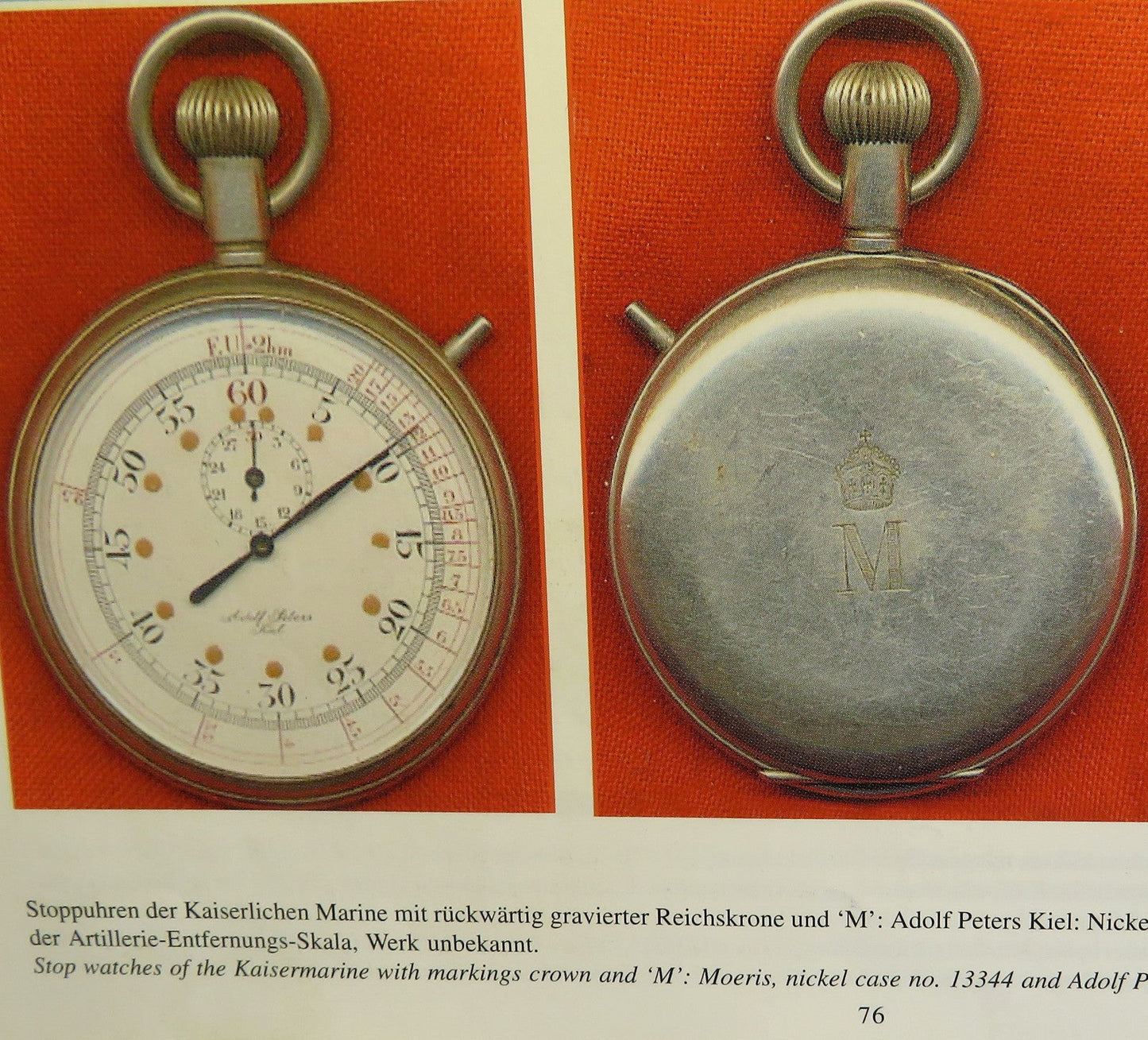
Military watch expert Konrad Knirim shows and describes this extended reset button on page 254 of his "Bible of Military Watches" - using a Junghans stopwatch with a dial that is identical except for the luminous dots (see photos).
A super rare piece of military and naval watch history, the likes of which only very rarely come onto the market. In my 30 years of passionately collecting military watches, I have never before held such a model with an extended reset button in my hand, or even seen it in a museum, collection or at an auction.
Description:
This 100% original torpedo timer/stopwatch has the dimensions typical for naval use: 50mm case diameter, very rare "Junghans" signed white dial with top-mounted indirect seconds, onion crown, extremely rare Kriegsmarine extended reset button for use in cold/damp weather with gloves.
The extremely rare naval artillery stopwatch was presumably fully signed on the back with "Kriegsmarine" and a boat or usage number underneath, as was customary for the Imperial Navy from 1918 after the abdication of the Kaiser until 1933 (see photos; even the most elaborate naval chronometers from Lange & Söhne or similar were signed in exactly the same way).
This signature has been completely removed; the grinding marks are still visible on the case back.
The additional luminous dots on the dial, which Konrad Knirim shows on page 76 in an artillery stopwatch by Adolf Peters from the pre-World War I period, suggest the beginning of this period; these luminous dots were no longer used by the navy from the 1920s onwards.
The dial shows the 60-unit division typical of Junghans watches, but with a super rare artillery scale made exclusively for this small series for the Kriegsmarine, in unrestored, undamaged, mint condition.
It features the rare Junghans caliber 68 movement.
This is exactly the Kriegsmarine Artillery special dial shown by Konrad Knirim, produced in a very small edition.
Good, used collector's condition! Winds smoothly, starts and runs (accuracy not tested), unrestored dial flawless, luminous dots perfectly and completely intact, all covers close flush.
EZ 1: Excellent condition for its age, barely noticeable signs of use, unrestored, flawless dial, runs and keeps time, lid closes flush, movement clean, former case back signature ground off
In 1860, the merchant Erhard Junghans, together with his brother-in-law Jakob Zeller-Tobler, founded an oil mill in Schramberg, which, however, proved to be a financial failure. In 1861, Erhard Junghans, along with his brother Xaver Junghans, who had returned from the USA, founded the company Gebrüder Junghans (Junghans Brothers) in Schramberg. Initially, they manufactured watch cases for other clock manufacturers in the Black Forest. From 1866/67 onwards, they were able to produce their first clock movements. Daily production reached approximately 60 clocks in 1870.
Erhard Junghans died in the autumn of 1870, whereupon his widow, Luise Junghans, took over the management of the company. On July 1, 1875, Luise Junghans sold the Junghans company to her sons, Erhard Jr. and Arthur; according to the partnership agreement, the elder son, Erhard Jr., assumed both the commercial and technical management. In the years following the takeover, Arthur Junghans, who had previously worked for a year in American watch factories, initiated a series of technical modernizations.[1] At the end of the 1870s, Junghans also began manufacturing alarm clocks based on American models, which led to a significant expansion of the company. As early as 1883 and again in 1894, Arthur Junghans attempted to establish a production line for simple pocket watches . However, a series of failures forced him to abandon these efforts. Through the merger with the Schwenningen-based company Thomas Haller AG , which had been successfully manufacturing and marketing pocket watches since the mid-1890s, Junghans was able to expand its product range to include pocket watches from 1900 onwards.
In 1888, the company presented a five-pointed star with a "J" in its center as its trademark . In 1890, this star gained eight points and remains the company's trademark to this day. In 1903, Junghans was the world's largest watch manufacturer, with more than 3,000 employees and an annual production of over three million watches. In 1906, Junghans also began manufacturing munition fuses, which were produced in large quantities in Schramberg during the First World War.
In 1928, Junghans began producing wristwatches , initially using movements purchased from Gebrüder Thiel GmbH in Ruhla . From 1930 onward, Junghans manufactured its own movements. At the same time, the company began collaborating with the French firm ATO , producing the eponymous electric pendulum clocks until 1962.
After the National Socialists seized power , Junghans was reoriented towards arms production by its Director General, Erwin Junghans (born 1875, died 1944, son of Arthur Junghans). Due to the war preparations, Junghans applied for and received numerous armaments contracts (precision watches for aircraft and ships, as well as ammunition fuses of all kinds). During the war years, over 9,000 employees produced primarily fuses and other armaments in bombproof facilities in Schramberg. Fuses developed by Junghans were also manufactured on a very large scale by other companies, particularly in Pforzheim, which led to the total destruction of Pforzheim by the Allies. Junghans also established branch plants for the production of armaments in other cities under neutral names (e.g., "MESSAP" in Hamburg). In Mühlheim an der Donau, Junghans, together with the Mühlheim clock factory, operated its own firing range for testing ammunition.
In 1942, Junghans housed 440 " Eastern Workers " (Ostarbeiter), 332 prisoners of war and forced laborers from France, and 90 forced laborers from Poland in Schramberg. The French workers were mostly accommodated in communal lodgings or guesthouses, while the Soviet and Polish workers lived in barracks. After the end of World War II, the French military administration dismantled and transported significant machinery to France, but the production of civilian watches was able to resume as early as 1946. Several company buildings were requisitioned by the Allies for use as barracks for a period of time. Furthermore, Junghans was forced to supply loose watch movements to France, which, however, were not sold in France but abroad under the brand names of French watch manufacturers.
After the war, Junghans focused on producing high-quality wristwatches to regain its reputation with customers. As a result, Junghans became the largest manufacturer of chronometers in the 1950s. in Germany, for example with the Junghans Chronometer, launched in the early 1960s for about 160 DM with the movement caliber J 85 .[8][9]
In 1956, the Junghans family lost their company and management as part of a hostile takeover by Diehl in Nuremberg . The official takeover took place on November 15, 1956. The Diehl Group continued to operate the watch and detonator technology divisions separately.
In 1972, Junghans provided the official timekeeping equipment for the Summer Olympic Games in Munich.